Cabinet Woods and Finishes for Coastal Homes
Cabinetry a mile from the ocean lives a different life than cabinetry twenty miles inland. The air holds more water, the swings are sharper when a hot dry wind arrives, and the light off the water is harder on a coating than most people expect. None of that argues against wood. It argues for choosing the wood, the coating and the metal on purpose.

What does living near the water do to a cabinet?
Three separate things, and each one goes after a different part.
The first is moisture, and it works on the material. Wood and wood products take water out of the air and give it back again, changing size while they do it. On any single day the movement is tiny. Across years it is relentless, and it is what opens a hairline where a painted panel meets its frame, what makes a drawer that ran sweetly in March start dragging in August.
The second is salt, and it works on the metal. Salt does very little to a finished door. It goes after the hinge behind that door, the slide under the drawer, and the screws holding either one.
The third is light. Sun through a west window changes the color of wood, and it changes it unevenly, so the part of a run standing in the light stops matching the part that never sees it.
Which woods hold up best?
Stability is the property worth paying for, and stability comes as much from how a board was cut as from what tree it came off.
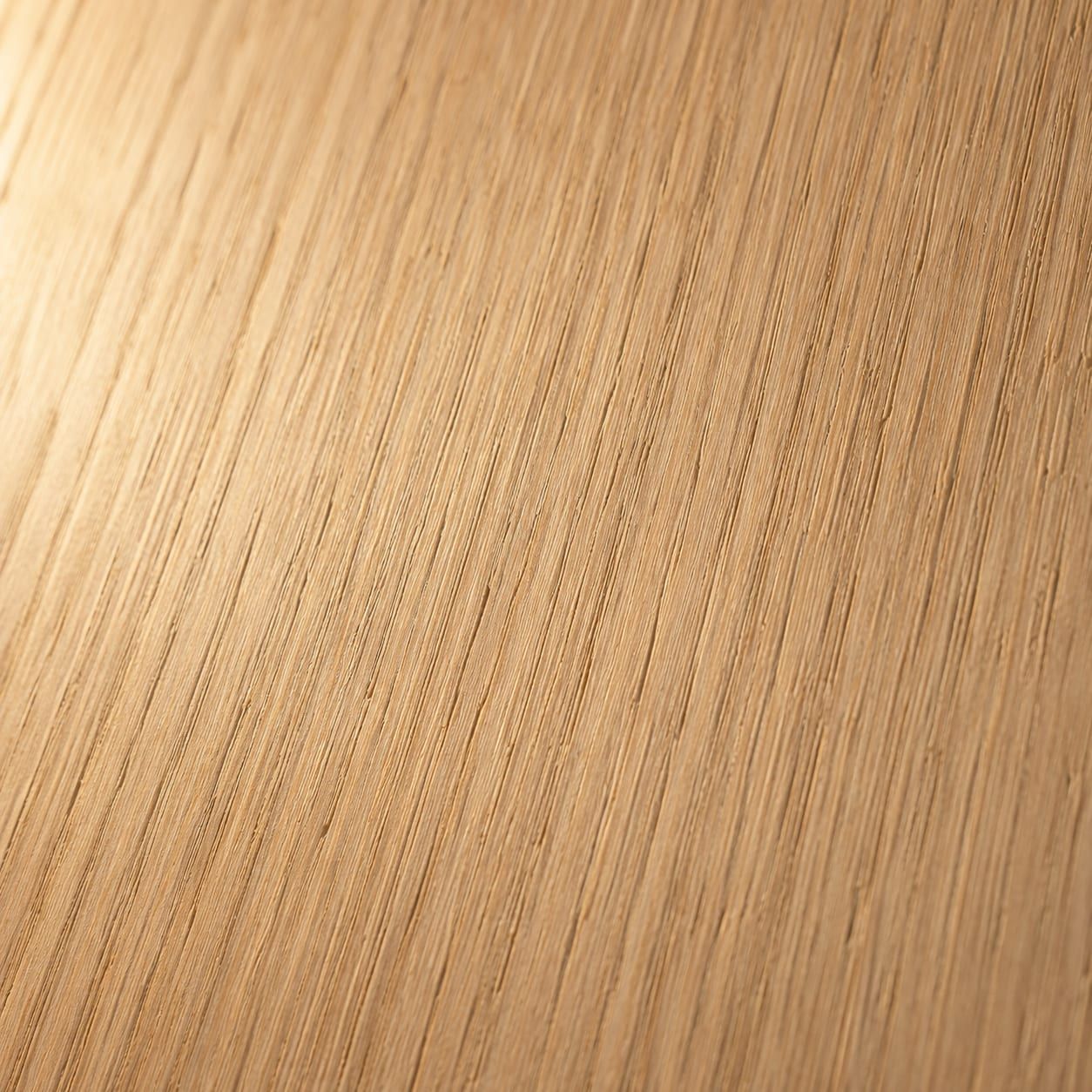
Rift and quarter sawn white oak is the most reliable choice for a kitchen near the water, and a fair part of why it has been popular for a decade. The growth rings sit close to perpendicular to the face, so the board moves far less across its width than a plain sawn board of the very same species. The figure reads as straight parallel lines rather than the arching pattern people call cathedrals, which you will either like or not.
Maple is dense, tight grained and nearly featureless, which is why it is the standard choice underneath paint. It carries a sprayed coating flatter than any open grained species can.
Walnut is stable and looks like nothing else, with one caveat handled further down: in sunlight it goes lighter rather than darker.
The species to think twice about are the soft ones. Pine, poplar and alder dent under ordinary kitchen use, and a dented coating is a broken coating, which is exactly the opening damp air is waiting for.
Whichever species you land on, a five piece door copes with movement better than a slab of solid timber, because the center panel floats loose inside its frame instead of being pinned at the edges. That is not a styling decision. It is the reason the joint was invented.
Why the carcass matters more than the door
Doors get chosen carefully and carcasses get assumed, which is backwards this close to the beach. A door lives in conditioned air and gets wiped down. A carcass sits against an outside wall, under a sink, behind a dishwasher, and nobody looks at it for fifteen years.
Plywood is what to insist on there. It is built from thin layers glued with their grain running in alternating directions, which is precisely the thing that stops it expanding one way and staying expanded. Particleboard has no grain direction to argue with, so when it takes on water it grows and never comes back down. That single difference is why one sink base dries out after a leak and another has to be cut out.
Two details carry as much weight as the panel choice. Every cut edge wants sealing, since a raw edge is the fastest road water has into any sheet material. And cabinet bottoms want coating on both faces rather than only the one you can see. Our custom cabinets are put together that way as a matter of course. It is a dull specification, and it is what keeps a splash from reaching bare material in the one cabinet most likely to meet water.
What finish should you ask for?
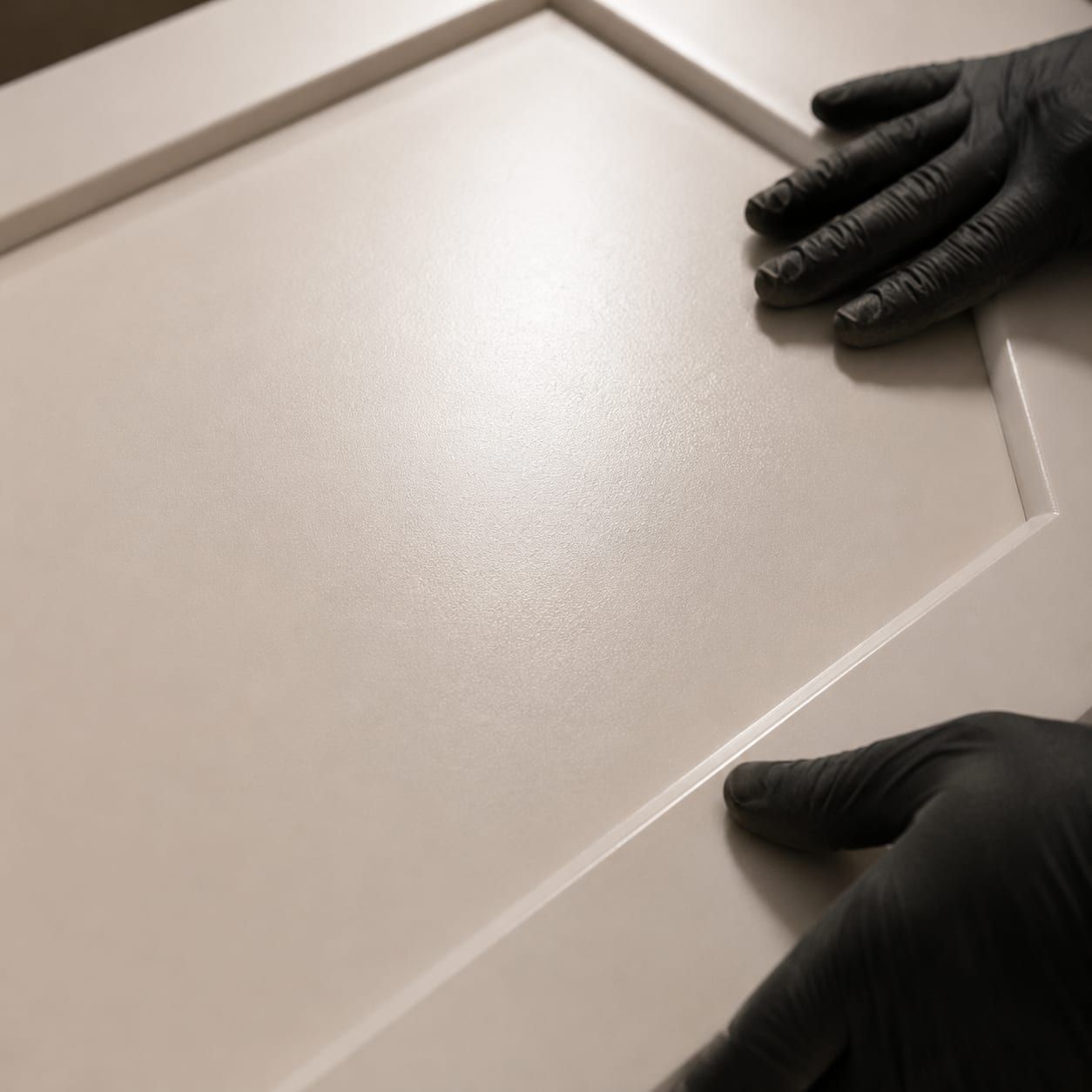
Ask for it sprayed and cured before the cabinetry reaches the house, rather than brushed on once it is hanging. That is not about neatness. A sprayed coating lands at an even thickness across the face, wraps the edges and the backs, and hardens in controlled conditions. A brush leaves its thinnest film in exactly the places that need the most, which are the edges and the bottom rail.
On sheen, satin is the sensible default. High gloss shows every ripple underneath it and every fingerprint on it, and it shows both worst on the doors nearest a window. A very flat matte hides shape well but marks easily and is harder to wipe, which matters more in a kitchen than anywhere else in a house.
Ask two questions of whoever is coating your cabinetry. Are the interiors coated, and are the backs and the bottoms coated. An uncoated interior is an unsealed sheet of material with a door standing in front of it, and in air like this that is the part that goes first.
What does the sun do to a stained finish?
It moves the color, and no clear coat stops that completely. Walnut lightens and loses some depth. White oak goes amber and then settles. Cherry darkens quickly. Paint keeps its color much longer but can chalk in hard direct light.
None of that is a defect and all of it is predictable, so the useful response is to plan around it rather than fight it. Keep the strongest light off the fronts with a shade, a blind or low emissivity glass, particularly in a west facing room where the sun comes in low all afternoon. Pick a species whose change you are happy to live with. And where one section of a run stands in full light while the rest sits in shade, expect the two to drift apart over the years, which is a real argument for paint in that particular room rather than for stain.
The same reasoning runs harder on an exposed lot. A house in Sunset Beach takes sun and salt from the same side all year, and the fronts facing that side are the ones that report it first.
Which hardware survives salt air?
Stainless steel, or a hardware finish rated for marine and coastal service, hung with stainless screws. Ordinary zinc plated hinges and slides pit first, stiffen next, and then stop letting a door sit where it was set. All of that happens out of sight, and the first symptom anybody notices is doors that no longer line up with each other.
Measured against the cabinetry, the extra cost across a whole kitchen is small. What it buys is doors that still close correctly in year ten, which is when everybody finally finds out what was specified.
Two rooms punish a wrong choice fastest. Custom bathroom cabinets live with steam every single day, and garage cabinets live in unconditioned air behind a door that opens straight onto the street. Both deserve a harder specification than the kitchen gets, not a softer one, and both are where cutting the hardware budget shows up soonest.
The short specification to ask for
If you want one paragraph to carry into any cabinet company in this county: plywood carcasses with every cut edge sealed, five piece doors with panels left free to move, rift sawn white oak or a tight grained maple under paint, a sprayed and cured satin coating that reaches the interiors, the backs and the bottoms, and stainless or coastal rated hinges, slides and screws throughout.
None of that is exotic and none of it is expensive set against the size of the job. It is simply what lasts in this air. Anyone quoting you should be able to confirm each line of it without hesitating, and a quote that goes vague on the parts you cannot see is telling you something useful about the parts you can.
A free visit to measure the rooms, and a written price after it, will tell you what that specification costs, with the species and the sheen settled in front of you rather than guessed at.
Talk through materials with no charge
Free in-home consultation and a written quote.