How to Read a Cabinet Quote
The price is the last line of the document. Everything above it decides whether that price means anything, and it is the part most people skip. A complete quote tells you what is being made, out of what, how it gets coated, who turns up and for how many days, and where the number stops. Here is how to read one from the top.
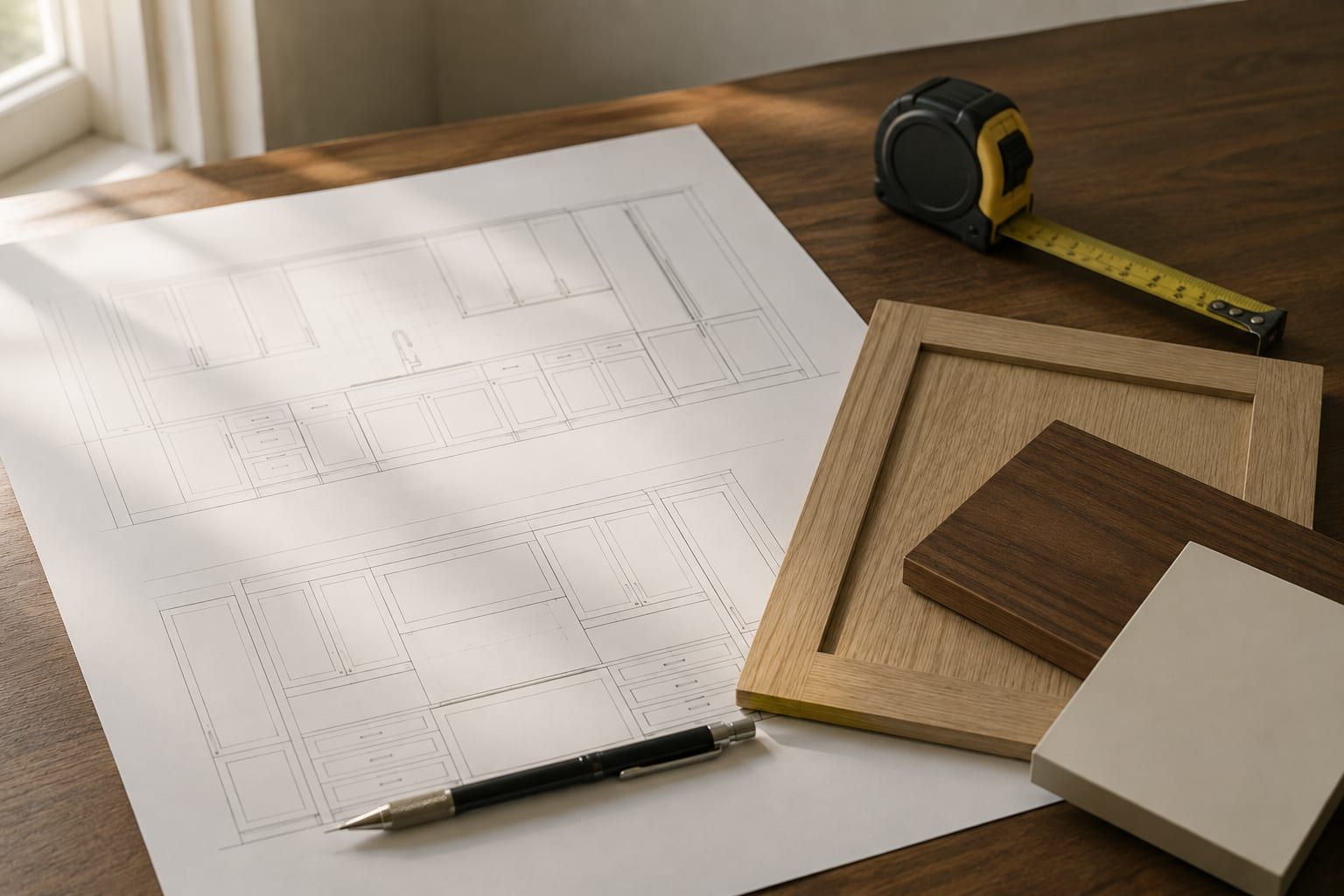
What belongs in a complete cabinet quote?
Six parts, and you can check every one of them without knowing anything about woodwork.
Scope. Which rooms, which walls, and whether pulling the old cabinetry out belongs to the shop or to you.
A count. How many pieces are being made, usually split into base units, wall units and tall units, with drawer banks noted separately from doors.
Materials. What the carcasses are cut from, what the fronts are made of, and which brand of hinge and slide is going on them.
Finish. A named color or stain, a sheen, and a statement about how far the coating reaches.
Install. A number of working days on site, and a rough window for them.
Exclusions. A written list of what the figure does not reach.
A quote carrying all six is a quote you can hold somebody to. One carrying a total and a paragraph of description is not a worse company, but it is a worse document, and you are allowed to ask for a better one.
Why start with the count?
Because the count is the one line you can check against your own house. Take the list of units, stand in the room and walk it. Does the number of tall pieces match what you pictured. Is the corner accounted for, and as what. Are the deep drawers you asked for listed as drawer banks, or has the base run quietly gone back to doors.
Doing that once catches most of the honest slips that reach a homeowner. A unit forgotten at the end of a run. An appliance panel left off. A pantry section that came up at the visit and never made it onto the sheet. All of those are free to fix while the job is still a piece of paper. None of them are free to fix after parts have been cut.
The count is also what makes a second quote comparable. Two shops given the same room can answer it with different numbers of pieces, and the one listing fewer is not automatically the cheaper job. Fewer and wider units can mean the same storage for less money, or it can mean a blind corner where you wanted a pull out. The count is where you find out which.
What should the materials line name?
Names, not adjectives. A materials line reading as quality hardwood construction has told you nothing anybody can check in ten weeks. A useful one names the sheet the boxes are cut from, the species or substrate behind the fronts, and the maker of the hinges and slides.
Three details are worth having on the page rather than agreed over the phone. What the shelves are, since shelving is sometimes a thinner or cheaper board than the carcass around it. What the drawer boxes are, and whether that construction is used throughout or only in the pieces you will open most. And what the backs are, because a back panel is the part nobody ever looks at and the part that stiffens the whole assembly.
You are not being difficult by asking. Anybody who specified those things already knows the answers and can write them down in a minute. Getting them onto paper simply means the cabinet that arrives is the cabinet you were shown.
What should the finish line say?
Four things: the color or stain by name or sample number, the sheen, where the coating is applied, and how far into the piece it goes.
A color written as soft white is not a color. A color written as a manufacturer reference, with a sample you have physically held, is a color, and it is the one that turns up. Sheen deserves the same treatment, because satin, matte and gloss read as three different rooms once daylight hits them, and nobody wants to learn that on delivery day.
Where and how far are the two people forget. A line saying the fronts are sprayed at the shop describes a different job than one where coating happens in your kitchen after the boxes are hung. A coating that stops at the outer faces is a different product than one that also runs over the inside faces, across the back panel and under every bottom. Neither answer is wrong for every project. Both belong on the page.

How many days on site does it allow?
This is the line homeowners look at last and remember longest, because it is the only stage that takes place inside your own kitchen. The quote should say how many working days the crew expects to need, and whether taking the old cabinetry out sits inside that figure or ahead of it.
Ask what happens when the walls turn out worse than they looked. Every fitter meets a floor that falls away or a wall that bows, and the answer you want is that packing and scribing are already inside the price. That is ordinary work rather than a surprise, and cabinet installation quoted with no allowance for it is the version that produces an awkward conversation halfway through the week.
The other thing worth having in writing is who is coming. Some companies hang what they built. Some hand fitting to a crew they use regularly. Both can be excellent. You simply want to know which one is arriving, and who you call if a door is not sitting right a month later.
What does the exclusions section tell you?
More about a shop than almost anything else on the page. Cabinetry sits in the middle of a room several other trades are also being paid for, and that boundary is the easiest thing in the world for two written prices to disagree about while neither of them is wrong.
A useful exclusions section is specific about where the boundary falls. It names the work surface and says who templates it. It says whether an appliance panel is drawn and made here or bought elsewhere. It says who is responsible for the wall behind the run being flat and painted before install week. It says whether permits, on a job that needs them, are yours to pull.
None of that is a shop protecting itself. It is a shop telling you what still needs organizing, which is worth roughly as much to you as the price is. A document with no exclusions on it is not a more generous offer. It is one where all of those questions are still open.
Which lines are worth a follow up question?
Four, and none of them mean anybody is trying to slip something past you. Documents get written fast by people carrying the whole job in their head, and asking is simply how detail moves from a head onto a page.
An allowance with nothing behind it. A hardware allowance is normal. A hardware allowance with no brand, no model and no unit price is a figure that can move after signing, so ask what it buys and what happens if you pick something more expensive.
A total with no parts. A single number for a whole kitchen is hard to compare and impossible to adjust. Drop the island or add a pantry later and a quote with no breakdown has to be written again from nothing.
A price with a very short shelf life. Material costs genuinely move, so an expiry date is fair. What is worth asking about is a price expiring so soon you could not get a second one in the meantime. Ask for long enough to compare properly, and expect a reasonable yes.
A deposit due before drawings exist. Money before cutting starts is normal and reasonable. What you want first is a drawing set with real dimensions on it, because the drawing is the thing the price is fastened to. Paying against a conversation leaves neither side anything to measure the finished room against.
How do you compare two quotes fairly?
In an order, and the totals come last.
Match the scope first. If one document covers the utility room while the other stops at the kitchen doorway, you do not yet have two prices for one job, and every later step is noise until that is straightened out.
Set the two exclusion sections side by side next, and mark anything appearing on one page but not the other. Every mark is a cost that lands somewhere eventually, and the document that stayed quiet about it is not the one that avoided it.
Then compare counts, piece for piece. Then the specifications, which is where most of a real gap lives: drawers against doors, inset against overlay, a named hardware brand against an unnamed one, interiors coated against interiors left bare.
Only after all that, look at the money. A figure sitting a long way outside what work like this normally runs to around here is a prompt to ask what the two documents are counting differently, rather than a verdict on either shop. Our page on custom cabinets cost publishes the bands a kitchen, a vanity, a wall of built-ins and a garage typically land in locally, which gives you something outside both quotes to hold them against.

The short version
Read the count first, because it is the only line you can verify yourself. Read the exclusions second, because they decide what the total covers. Read materials and finish third, because they are what you look at every day for fifteen years. Read the price last.
Anything thin on the page is a question rather than a verdict. The shops worth hiring answer those questions in plain words and put the answers in writing, and the asking costs you nothing whichever way you go.
If you want a document laid out that way for your own room, ask us for a free written quote. Somebody measures, drawings follow with real dimensions on them, and the price is fastened to those drawings. Every quote this shop writes for custom cabinets follows the order above, and reading one costs you nothing at all.

Get a quote you can actually check
Free in-home consultation and a written quote.